At the heart of new roof system is a proprietary inorganic phase change material sandwiched between two reflective surfaces made of aluminum foil. This material is installed as a dynamic thermal barrier between the roof and attic area, creating separate air channels between roof rafters. The configuration is compatible with traditional wood and steel framing technologies. Moreover, the new phase change material overcomes problems that have plagued phase change materials for the past 40 years.
"In the 1970s and 1980s the housing industry made several moderately successful attempts to use phase change materials," Kosny said. "While these materials enhanced building energy performance, they were in many cases chemically unstable, were subject to corrosion or other durability problems and suffered from loss of phase change capability."
Another shortcoming of some previous phase change materials was their susceptibility to fire. Fire is not a problem with the ORNL material, according to Kosny, who noted that ORNL researchers are working with leading manufacturers of phase change material on the development of non-flammable organic material.
In tests at ORNL, phase change materials perform like conventional materials by absorbing heat as the temperature increases. However, as the material melts it continues to absorb large amounts of heat without a significant increase in temperature. Then, as night falls and the ambient temperature around the liquid phase change material decreases, it solidifies again and releases the stored heat to the night sky, Miller said.
With an outside temperature of 92 degrees Fahrenheit, tests at ORNL's Buildings Technology Center show temperatures of conventional attics at 127 degrees Fahrenheit vs. attic temperatures of 105 degrees with the Dynamic Attic Heat Exhaust System. Kosny and Miller filed a patent last year for this technology.
"The next generation roof will consist of infrared reflective materials that are dark in color yet reflect light as if they were white," Miller said. "In addition, radiant barriers and phase change materials will be integrated into a dynamic attic system that reduces utility bills for homeowners. The conservation strategies contribute on a much grander scale by lowering peak demand on utilities, reducing carbon emissions and, ultimately, they could lead to cleaner air."
If just half of the homeowners in the U.S. made sure they had R30 attic floor insulation and used this roof and attic system, the nation could reduce its Btu (British Thermal Unit) demand by about 100 trillion Btu.
This research is funded by the DOE Office of Energy Efficiency and Renewable Energy's Building Technologies program. UT-Battelle manages Oak Ridge National Laboratory for the Department of Energy.
August 30, 2007
Roof Design - For Energy Saving
0
comments
CLICK TO (read) COMMENT
Labels:
Energy Savings,
Updates
Technorati:
Energy Savings,
Updates
August 27, 2007
God & Science
This story was sent to me by a friend & thought I should share it with you all.
An atheist professor of philosophy speaks to his class on the problem science has with God, The Almighty. He asks one of his new students to stand and.....
Prof: So you believe in God?
Student: Absolutely, sir.
Prof: Is God good?
Student: Sure.
Prof: Is God all-powerful?
Student: Yes.
Prof: My brother died of cancer even though he prayed to God to heal him. Most of us would attempt to help others who are ill. But God didn't. How is this God good then? Hmm?
(Student is silent.)
Prof: You can't answer, can you? Let's start again, young fella. Is God good?
Student: Yes.
Prof: Is Satan good?
Student: No.
Prof: Where does Satan come from?
Student: From...God...
Prof: That's right. Tell me son, is there evil in this world?
Student: Yes.
Prof: Evil is everywhere, isn't it? And God did make everything. Correct?
Student: Yes.
Prof: So who created evil?
( Student does not answer.)
Prof: Is there sickness? Immorality? Hatred? Ugliness? All these terrible things exist in the world, don't they?
Student: Yes, sir.
Prof: So, who created them?
( Student has no answer.)
Prof: Science says you have 5 senses you use to identify and observe the world around you. Tell me, son...Have you ever seen God?
Student: No, sir.
Prof: Tell us if you have ever heard your God?
Student: No, sir.
Prof: Have you ever felt your God, tasted your God, smelt your God? Have you ever had any sensory perception of God for that matter?
Student: No, sir. I'm afraid I haven't.
Prof: Yet you still believe in Him?
Student: Yes.
Prof: According to empirical, t estable, demonstrable protocol, science says your GOD doesn't exist. What do you say to that, son?
Student: Nothing. I only have my faith.
Prof: Yes. Faith. And that is the problem science has.
Student : Professor, is there such a thing as heat?
Prof: Yes.
Student : And is there such a thing as cold?
Prof: Yes.
Student : No sir. There isn't.
(The lecture theatre becomes very quiet with this turn of events.)
Student : Sir, you can have lots of heat, even more heat, superheat, mega heat, white heat, a little heat or no heat. But we don't have anything called cold. We can hit 458 degrees below zero which is no heat, but we can't go any further after that. There is
no such thing as cold. Cold is only a word we use to describe the absence of heat. We cannot measure cold. Heat is energy. Cold is not the opposite of heat, sir,
just the absence of it.
(There is pin-drop silence in the lecture theatre.)
Student : What about darkn ess, Professor? Is there such a thing as darkness?
Prof: Yes. What is night if there isn't darkness?
Student : You're wrong again, sir. Darkness is the absence of something. You can have low light, normal light, bright light, flashing light....But jif you have no light constantly, you have nothing and it's called darkness, isn't it? In reality, darkness isn't. If it were you would be able to make darkness darker, wouldn't you?
Prof: So what is the point you are making, young man?
Student: Sir, my point is your philosophical premise is flawed.
Prof: Flawed? Can you explain how?
Student : Sir, you are working on the premise of duality. You argue there is life and then there is death, a good God and a bad God. You are viewing the concept of God as something finite, something we can measure. Sir, science can't even explain a thought. It
uses electricity and magnetism, but has never seen, much less fully understood either one. To view death as the opposite of life is to be ignorant of the fact that death cannot exist as a substantive thing. Death is not the opposite of life: just the absence of it.
Now tell me, Professor. Do you teach your students that they evolved from a monkey?
Prof: If you are referring to the natural evolutionary process, yes, of course, I do.
Student : Have you ever observed evolution with your own eyes, sir?
(The Professor shakes his head with a smile, beginning to realize where the argument is going.)
Student : Since no one has ever observed the process of evolution at work and cannot even prove that this process is an on-going endeavor, are you not teaching
your opinion, sir? Are you not a scientist but a preacher? (The class is in uproar.)
Student : Is there anyone in the class who has ever seen the Professor's brain?
(The class breaks out into laughter.)
Student : Is there anyone here who has ever heard the Professo r's brain, felt it, touched or smelt it? No one appears to have done so. So, according to the established rules of empirical, stable, demonstrable protocol, science says that you have no brain,sir.
With all due respect, sir, how do we then trust your lectures, sir?
(The room is silent. The professor stares at the student, his face unfathomable.)
Prof: I guess you'll have to take them on faith, son.
Student: That is it sir... The link between man & god is FAITH. That is all that keeps things moving & alive.
I believe you have enjoyed the conversation...and if so...you'll probably want your friends/colleagues to enjoy the same...won't you?...forward them to increase their knowledge... this is a true st ory, and the student was none other than.........
APJ Abdul Kalam ,
The President of India
1
Comment
CLICK TO (read) COMMENT
Labels:
Interesting Facts
Technorati:
Interesting Facts
August 25, 2007
Booster Pumps - Improve your vacuum system performance
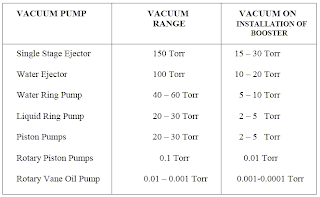
Mechanical vacuum boosters are dry pumps that meet most of the ideal vacuum pump requirements. They work on positive displacement principle and are used to boost the performance of water ring / oil ring / rotating vane / piston pumps and steam or water ejectors. They are used in combination with any one of the mentioned pumps, to overcome their limitations. Vacuum boosters pumps offer very desirable characteristics, which make them the most cost effective and power efficient option.
Major Advantages
1. Can be integrated with any installed vacuum systems such as steam ejectors, water ring pumps, oil sealed pumps, and water ejectors etc.
2. The vacuum booster is a dry pump, as it does not use any pumping fluid. It pumps vapor or gases with equal ease. Small amounts of condensed fluid can also be pumped.
3. Vacuum boosters are power efficient. Very often a combination of vacuum booster and suitable backup pump result in reduced power consumption per unit of pumping speed. They provide high pumping speeds even at low pressures.
4. Boosters increase the working vacuum of the process, in most cases very essential for process performance and efficiency. Vacuum booster can be used over a wide working pressure range, from 100 Torr down to 0.001 Torr (mm of mercury), with suitable arrangement of backup pumps.
5. It has very low pump friction losses, hence requires relatively low power for high volumetric speeds. Typically, their speeds, at low vacuums are 20-30times higher than corresponding vane pumps/ring pumps of equivalent power.
6. Use of electronic control devices such as variable frequency control drive allows modifying vacuum boosters operating characteristics to conform to the operational requirements of the prime vacuum pumps. Hence they can be easily integrated into all existing pumping set up to boost their performance
7. Vacuum boosters don’t have any valves, rings, stuffing box etc, therefore, do not demand regular maintenance.
8. Due to vapor compression action by the booster, the pressure at the discharge of booster (or inlet of backup pump) is maintained high, resulting in advantages such as low back streaming of prime pump fluid, effective condensation even at higher condenser temperatures and improvement of the backup pump efficiency.
3
comments
CLICK TO (read) COMMENT
Labels:
Energy Savings,
Interesting Facts,
Updates
Technorati:
Energy Savings,
Interesting Facts,
Updates
August 24, 2007
Acetic Acid Heat Exchanger Failure
We have a shell & tube heat exchanger as feed preheater in our glycol ether acetate plant where mixed feed is preheated to ~130-140°C using steam on shell side. It has failed recently & we observed few strange things.
Background
In the process of manufacturing of Glycol ether acetate (Or Cellosolve acetate) we conventionally use Cellosolve & Acetic acid and esterification reaction occurs with the water formation in CSTR reactors. Toluene is used as entrainer for water removal.
After reaction step, the product mix is sent to mix fraction column separation where All unreacted components and toluene are removed as overhead & recycled back to the reactor.
Feed is mixed with this recycle stream & sent to a preheater upstream of the reactor. The mixture is preheated to ~130-140°C using steam.
Incident
On 17 Aug when we stopped the plant for some modification, we found the organic compounds in the condensate line for the reactors. So initially we thought about some leakages in the internal coils of the reactor but while opening up the flanges in the system we found that organics are not coming from the reactor side rather coming from the header side. So we isolated entire system & traced it back to this exchanger.
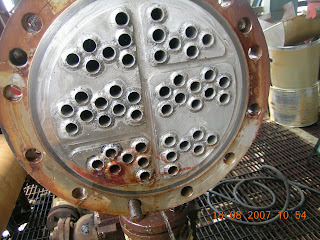
After confirmation from the drain point at max elevation, we decided to open it in the morning of 18 Aug and found this scene at site.
This is a 6 pass exchanger with organics on tube side & heating steam on shell side.
The tube failure was found on the inlet side of process fluid which is at left bottom in actual orientation also, as shown in the pic above.
It is clear from the pics that other tubes dont have even a single spot of corrsoion or leakge as shown above & below.
So what is the situation of failure at the time of opening of exchanger & why it is so?
Just another enlarged view of failed tubes at tubesheet end.........
We have inspected the tubes using boroscopy from inside & found that the actual leakage is inside the tubes at the end side of first pass (outlet side) not on the side shown (Inlet of first pass).
The picture above is showing a hole at the top left and severe pitting inside the tubes.
Our mechanical analysis is under progress & I will update this one as soon as I get those reports.
Till then I invite your comments.
1
Comment
CLICK TO (read) COMMENT
Labels:
Articles,
Shortcuts / Tips
Technorati:
Articles,
Shortcuts / Tips