


In the last post, i discussed about use of shear / dispersion component based impellers for most of the chemical applications in place of pitch blade trubines. Based on that our readers are asking for the coverage of all types of impellers for general understanding.

Therefore, I am giving some brief details on different mixing agitators.
I am starting the post from categorization of applications where they are used to understand their selection in a better manner. There are three basic categories of mixing applications as mentioned in previous article also.
1. Gas Liquid mixing.
2. Liquid Liquid mixing.
3. Solid Liquid mixing.
Now for all of these cases, there are three basic type of agitators.
1. Axial Impellers
2. Radial or Shear Impellers.
3. Special Impellers.
So let us first start understanding Axial impellers.
Axial Impellers
In this category of impellers the major action or fluid movement is in vertical or axial direction of impeller shaft & therefore, named as axial impellers.
The major impellers in this category is a pitch blade turbine, where different types of blades, at different angles, in different blade width are used for different services. the general design is a 3 blade impeller or more approapriately a propeller, which is used.
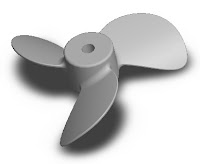

The above design is a propeller with 3 blades similar to chemineer AP-3 and lightinin A-100 etc. However the difference is up-pumping or down-pumping. You can guess how & which one is up and which one is down pumping in nature. The up pumping means the flow goes up near the shaft of the impeller & vice-versa for the down pumping.
The power no is very low for these impellers however, it is higher than some specially designed hydrofoil shapes of these blades. So variations are as below.


All the above impellers are axial in nature with wide variation in flow characteristics, power consumption, mixing pattern etc. Now let us go to Radial Impellers.
Radial Impellers
In this category of impellers the major action or fluid movement is in the same plane of rotation or it is shearing in nature & therefore, named as radial / shear impellers.
The major impellers in this category is a rushton turbine, where different types of blades, in different blade width & shape are used for different services. the general design is a 6 blade (flat) turbine which is also more commonly known as rushton turbine.


Special Impellers
The thrid category of impellers is the special design of impellers which are used mainly for specific services mostly involving highly viscous liquids e.g. anchor, helical etc.


Therefore, I am giving some brief details on different mixing agitators.
I am starting the post from categorization of applications where they are used to understand their selection in a better manner. There are three basic categories of mixing applications as mentioned in previous article also.
1. Gas Liquid mixing.
2. Liquid Liquid mixing.
3. Solid Liquid mixing.
Now for all of these cases, there are three basic type of agitators.
1. Axial Impellers
2. Radial or Shear Impellers.
3. Special Impellers.
So let us first start understanding Axial impellers.
Axial Impellers
In this category of impellers the major action or fluid movement is in vertical or axial direction of impeller shaft & therefore, named as axial impellers.
The major impellers in this category is a pitch blade turbine, where different types of blades, at different angles, in different blade width are used for different services. the general design is a 3 blade impeller or more approapriately a propeller, which is used.


The above design is a propeller with 3 blades similar to chemineer AP-3 and lightinin A-100 etc. However the difference is up-pumping or down-pumping. You can guess how & which one is up and which one is down pumping in nature. The up pumping means the flow goes up near the shaft of the impeller & vice-versa for the down pumping.
The power no is very low for these impellers however, it is higher than some specially designed hydrofoil shapes of these blades. So variations are as below.


All the above impellers are axial in nature with wide variation in flow characteristics, power consumption, mixing pattern etc. Now let us go to Radial Impellers.
Radial Impellers
In this category of impellers the major action or fluid movement is in the same plane of rotation or it is shearing in nature & therefore, named as radial / shear impellers.
The major impellers in this category is a rushton turbine, where different types of blades, in different blade width & shape are used for different services. the general design is a 6 blade (flat) turbine which is also more commonly known as rushton turbine.


Special Impellers
The thrid category of impellers is the special design of impellers which are used mainly for specific services mostly involving highly viscous liquids e.g. anchor, helical etc.


